
August 15, 2025 • 6 min read

Table of Content
The $5,000 Caregiver Tax Credit is an opportunity to support people who care for individuals every day. It can reduce your income tax payment, which can free up more funds for care-related expenses. This credit acknowledges their effort, time, and financial commitment that requires to be a caregiver. Not everyone can get it, but those who can may be able to get up to $5,000, depending on their situation. To get the most out of this benefit and put more money in your pocket, you need to know how to apply and what the restrictions are.
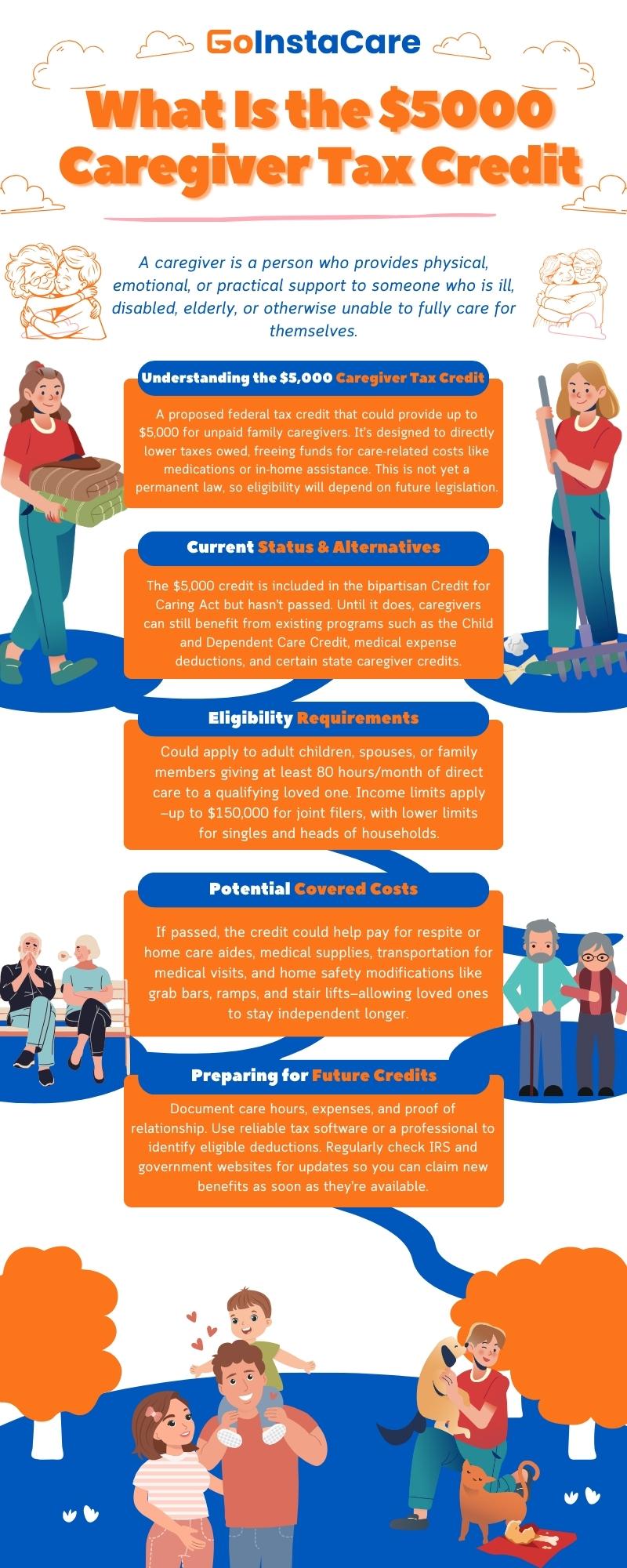
The $5000 Caregiver Tax Credit is a proposed federal benefit that would help family caregivers in the U.S. who don't get compensated. It has been talked about and publicized a lot lately, but it is not yet a permanent tax law, so future laws may change how available it is. The main purpose of this credit is to help people who care for a loved one right away, often without getting a consistent paycheck in the meantime.
If the benefit were to be set up, eligible caregivers may get up to $5,000 back on their federal tax return. This amount would be better than a simple deduction because it would lower the taxes owed by the same amount. Their money could help them to pay for their expenses such as prescription medication and home care assistance.
Caregiving for family members may be challenging on both your emotions and financial stability. It gives caregivers a tax free that makes it easier for them. This allows them to focus on good care without worrying about money.
The Credit for Caring Act, which has support from both parties in Congress, now contains the $5,000 Caregiver Tax Credit. This suggests that MPs from both major parties support the proposal because they recognize how crucial it is to support family caregivers. However, it has not yet become law. Caregivers can't claim this $5,000 credit on their federal tax return until it is officially passed.
But caregivers still have choices. Some of the tax credits and deductions that can assist in lowering the cost of providing care right now are the Child and Dependent Care Credit, the Dependent Exemption and medical expense deductions. Even though they might not offer you the same amount of money as the proposed $5000 credit, they can nevertheless have a big effect on your taxes.
In addition to federal benefits, several states offer their caregiver tax credits or deductions. For example, some jurisdictions give smaller tax breaks for medical expenses that you pay for yourself or for caring for a dependent. The qualifications to qualify for these state-level programs and the amounts of benefits they offer are very different. It's a good idea to check your state's revenue department website or talk to a tax professional to see if you qualify for them right now.
Adult children supporting aging parents with everyday tasks or medical care may qualify.
Spouses and other family members offering in-home care, whether part-time or full-time, are eligible, as long as they meet the required caregiving hours.
Caregivers must have provided at least 80 hours of direct, hands-on care each month to a qualifying family member.
Income limits apply: joint filers can earn up to $150,000 annually, with lower thresholds for single or head-of-household filers.
If it were put into effect, the $5,000 Caregiver Tax Credit might help pay for several things that often make it hard for caregivers to make ends meet. One key part of home care services is paying for trained aides or respite care so that the main caregiver can take a break. It may also cover medical products that are needed for everyday care, such as mobility assistance, wound care kits, or special health monitoring devices.
Transportation is another big cost for caregivers, especially when they have to accompany their loved one to multiple doctors' appointments each month. The credit might help pay for gas, public transit, or ride-sharing services to go to doctor's appointments. You can also use the credit to help pay for safety-related home renovations like adding grab bars, stair lifts, or ramps. These changes not only make things safer, but they also help loved ones stay independent for longer, which means they won't require as much expensive long-term care.
Caregivers may not yet be able to get the $5,000 Caregiver Tax Credit, but they can still take advantage of other tax savings that are worth their time. If you claim your parents as a dependent and pay for their care so you can work or look for work, you could get the Dependent Care Credit. The amount of the benefit depends on your income and expenses, but it can still save you a lot of money on taxes.
Another option is to take off medical costs. List your deductions and your loved one's medical expenditures beyond a certain amount of your adjusted gross income. You can claim eligible out-of-pocket expenses. This could include prescription drugs, medical supplies, and certain types of in-home care.
If your company offers a Flexible Spending Account (FSA), you can lower your taxable income by using pre-tax money to pay for medical or dependent care needs.
To get these benefits, you need to keep accurate records of all the costs associated with care. If you need help keeping track of and recording the costs of in-home care, you can call Instant Quality Care for your Loved Ones. Their services can make sure that your records are correct and it will be easier to apply for any tax free that you may be eligible for.
Keep your records safe of your caregiving journey including monthly care hours and documentation.
Use trusted tax software or connect with a qualified tax professional to help organize your records and explore possible deductions.
Checking official government websites so you have to be prepared of new tax credits as they roll out.
No, the caregiver tax credit of $5,000 is not available at this time. Under the Credit for Caring Act, it is still a proposal that needs to be approved. There are still other federal and state tax benefits available for caregivers.
Family members who earn money will take care of individuals for at least 80 hours a month and help a qualifying relative, like an elderly parent or spouse with daily requirements, be able to get the federal caregiver tax credit.
The caregiver tax credit may be able to pay for things like medical supplies, home care services and transportation for medical visits. This could help the caregiver pay for the costs of offering a qualifying family member continuous, hands-on support.
Caregivers can now get benefits including the Dependent Care Credit and Flexible Spending Accounts. This is different from the planned $5000 caregiver tax credit. But the rules and values of these programs are not the same.
To claim caregiver expenses, you need to keep detailed records, check that the dependent is eligible, and use IRS forms to claim any credits. Filing correctly makes sure you get all the tax breaks that apply to caregivers.
The $5,000 caregiver tax credit, which isn't in place yet, shows that people are starting to value the work that family caregivers do more. You can still lower your caring costs by checking into any tax breaks that could be available. Use GoInstaCare for professional assistance and get in touch with Instant Quality Care for your loved ones. This will make it easier and more effective to keep track of care and costs.
Cities
Houston
Dallas
Austin
San Antonio
Miami
Chicago
Find Here
Companies