
September 06, 2025 • 5 min read
Table of Content
AI is changing how families and caregivers provide companionship, safety, and support daily in child care and senior living. AI tools are used in everyday care for various tasks, such as keeping an eye on health indicators and keeping kids interested in learning through play. Families now have more choices for finding a balance between comfort and efficiency. Children can grow up in a safe place, and older people can live independently. These technologies make things faster and more reliable but make people less trusting, less private, and more reliant on human oversight. If they know the pros and cons, families can make better choices about AI and professional caregiving help at home or in care facilities.
The growing use of AI in caregiving is changing how kids and seniors get daily help. AI in healthcare helps caregivers keep track of medication schedules, vital signs, and early warning signs that can help prevent crises. Seniors can use AI-powered devices to keep track of their heart rate, blood pressure, and sleep patterns without having to go to the clinic often. Families can relax knowing that these tools will quickly find even small changes in health.
AI-based home monitoring systems give older people who live alone freedom and safety. Features like fall detection let caregivers know immediately if a loved one falls or can't move. Smart home devices can also remind seniors to take their medications or call for help in an emergency. This makes people react faster and makes living without constant supervision less dangerous.
AI gives parents new and interesting ways to help with child care. AI-powered learning assistants help kids with personalized learning activities, and virtual babysitters can keep kids interested by letting them interact with other kids online safely. These resources help parents instead of replacing them, especially when they need a short break or extra help with learning. AI is becoming a helpful part of the routines for caring for seniors and children by combining safety features with ways to keep them interested in learning.
Improved safety through real-time monitoring: AI tools like fall detection, health tracking devices, and child activity monitors provide instant alerts, helping caregivers respond quickly to emergencies and prevent serious risks.
Personalized learning or activity plans: AI-powered assistants create tailored routines for children and seniors from educational games and skills for children to memory support and activities for seniors.
Enhanced caregiver support and efficiency: Caregivers can use AI for scheduling, medication reminders, and progress tracking, reducing workload while ensuring consistent and reliable care. This lets them focus more on emotional and personal connections.
Cost savings in long-term care and childcare: By reducing hospital visits, preventing accidents, and supporting at-home learning, AI lowers the need for constant in-person supervision, helping families save on overall care expenses.
Accessibility for families in remote areas: Families in rural areas can use AI-powered educational tools where professional caregiving services may not be available.
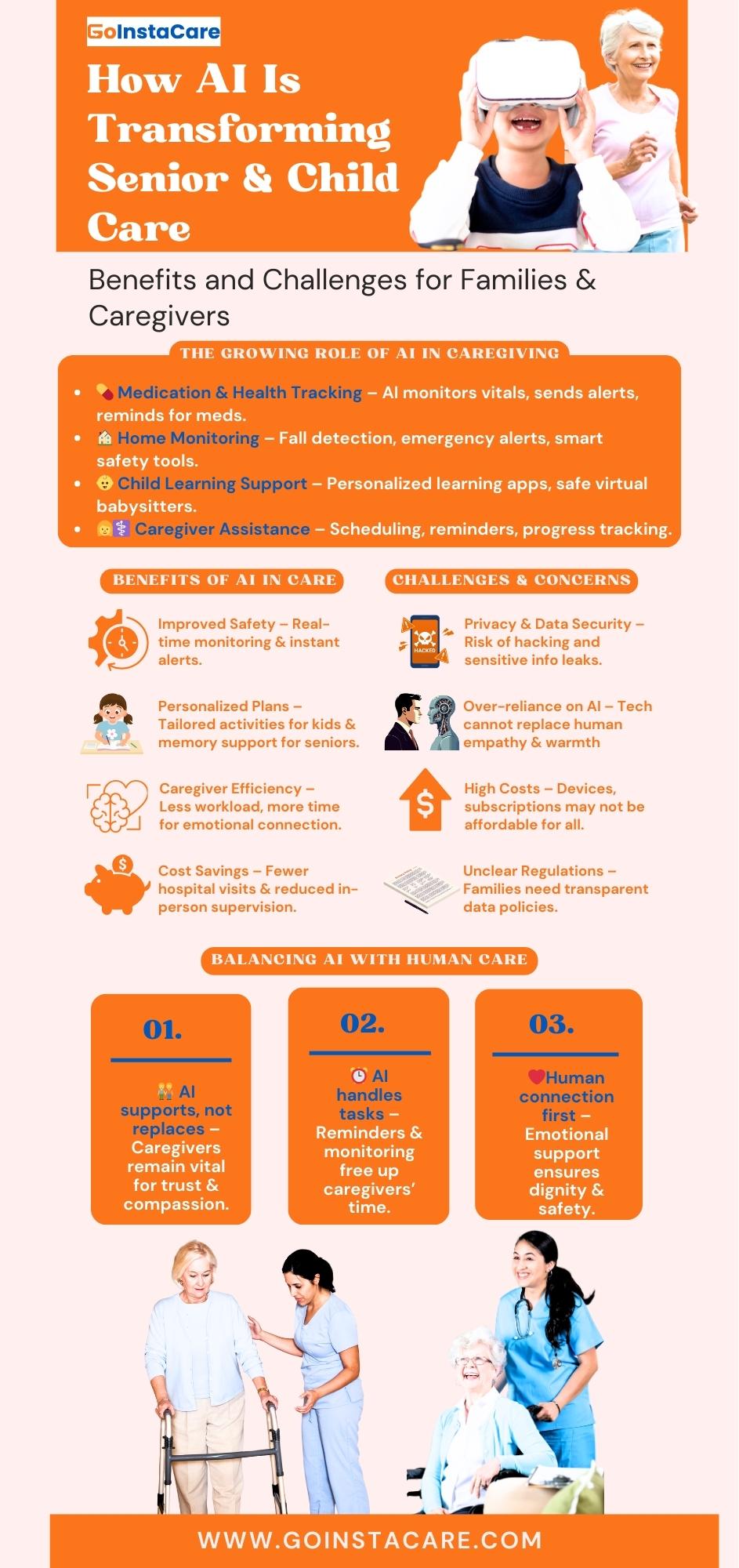
AI in the care of children and seniors has certain advantages but families need to think about the major issues. Privacy and data security are still the major problems. Families could worry about their loved one's private health if the devices that gather this information are easy to hack.
People also depend too much on AI instead of talking to one other. Children and seniors require comfort and emotional warmth that technology can't provide them. AI can help but caregivers need to create trust and deliver personalized care. Some families might not be able to employ smart monitors, health trackers, and AI-powered learning tools because they cost too much and need to be subscribed on a regular basis.
It is difficult to accept because of social worries about data on seniors and children. Families might not want to use these resources if the regulations aren't clear. Families need clear guidelines to ensure that private caregiving data is safe and responsible as AI becomes more prevalent in care.
To find a balance between AI and human care, it's essential to know that technology improves care but doesn't replace it. Caregivers are still highly important because they can demonstrate empathy, compassion, and build relationships that AI can't. Seniors and children often need the main elements of caregiving that offer emotional support and make them feel safe.
AI can help caregivers instead of taking their position. For example, it can remind patients to take their medicine or a check on their health. This provides caregivers more time to work on creating relationships with other people and finding the right balance between retaining the value of human care and ensuring that families get the benefits of AI's rapidity.
Some examples of AI in senior care that help with daily tasks and keep seniors safe, connected, and independent while also taking some of the work off of caregivers are fall detection devices, wearable health monitoring technology, medication reminder apps, and voice assistants.
Artificial intelligence is used in childcare as learning assistants, smart monitors, and virtual babysitters that keep track of activities, help with education, and let parents know what's happening. This makes things safer and more personalized for kids at home.
Families must carefully supervise and use AI in caregiving in a balanced way because of the main risks, which are privacy violations, less human interaction, high setup costs, and moral issues with sensitive data.
AI can't take the role of human caregivers because it doesn't have feelings or the ability to connect with others. Caregivers are important for taking care of children and seniors because they provide trust and comfort.
When deciding whether AI care tools are right for their family, families consider safety, costs, privacy risks, and emotional needs. They make sure that technology helps human caregivers and fulfills the daily requirements of their loved ones for support and health.
AI can make caregivers smarter but it can't offer kindness and understanding of human caregivers. AI devices can remind them to take their medicine and help children to learn. Still, they can't give you a comfortable feeling or the ability to understand how people feel when things are challenging. Families should know that technology is not a cure at all times but it should be used as a tool to help.
When you use AI, you need to know what it can and can't do and make the most of its benefits. It offers children to learn and for seniors, it gives them safety.
GoInstaCare can help your loved ones by offering high-quality care. Families can use AI when it makes sense and they can trust that real human care will always be helpful when trained caregivers know how to combine their professional skills with their kindness.
Cities
Houston
Dallas
Austin
San Antonio
Miami
Chicago
Find Here
Companies