
August 11, 2025 • 7 min read

Table of Content
To become a registered caregiver, you must meet a few basic standards that vary from state to state. These include training, passing a background check, and getting a CPR or first aid certification. Some states also need a competency test or registration with the local health department. Your qualifications show that you are qualified to help with basic health monitoring, reminding people to take their medicine, and performing other daily tasks. Getting certified gives you more job options and higher pay, whether you work for yourself or via an agency. To work as a professional caregiver in the United States, you first need to know what the rules are in your state.
A certified caregiver has completed official training and met state standards to help persons who need help with everyday duties without becoming a doctor. These caregivers often help dress, bathe, cook, move around, and remind individuals to take their medications. A caregiver's certification shows they can provide safe and effective care.
The main differences between certified and non-trained caregivers are their training and recognition. Non-certified caregivers have no experience and are limited to private, sometimes lower-paying work. Certified caregivers, on the other hand, complete approved programs and are often qualified for higher-paying professions. Also, accreditation makes people trust you more, especially if you work in a licensed care facility or agency.
Workplace | Certified Caregivers | Non-Certified Caregivers |
Private Homes | Yes | Yes |
Home Care Agencies | Yes | Sometimes (with supervision) |
Assisted Living Facilities | Yes | Rarely |
Nursing Homes | Yes (with added credentials) | No |
Not all states need certified caregivers, although many have specific rules based on the type of care they provide. States like California, Arizona, and New Jersey require caregiver certification for people who work for registered organizations or assisted living facilities. If you care for someone alone, other people may only need a little training or none. Always call your state's caregiving board or health department to determine the rules.
Many employers, such as home care agencies, hospice organizations, nursing homes, and assisted living institutions, want people to be certified. You often need proof of professional training, CPR certification, and background checks in these settings. Long-term contracts like Medicaid sometimes prefer licensed caretakers for safety and compliance, although private households may not need certification.
Term | Meaning | When It's Required |
Certification | Proof of completed training and skills assessment | Needed by most agencies and some states |
License | Government-issued permission to perform clinical care | Required for medical roles like CNAs or nurses |
Registration | Listing in a state-approved caregiver database | Common for state-funded or Medicaid-based care |
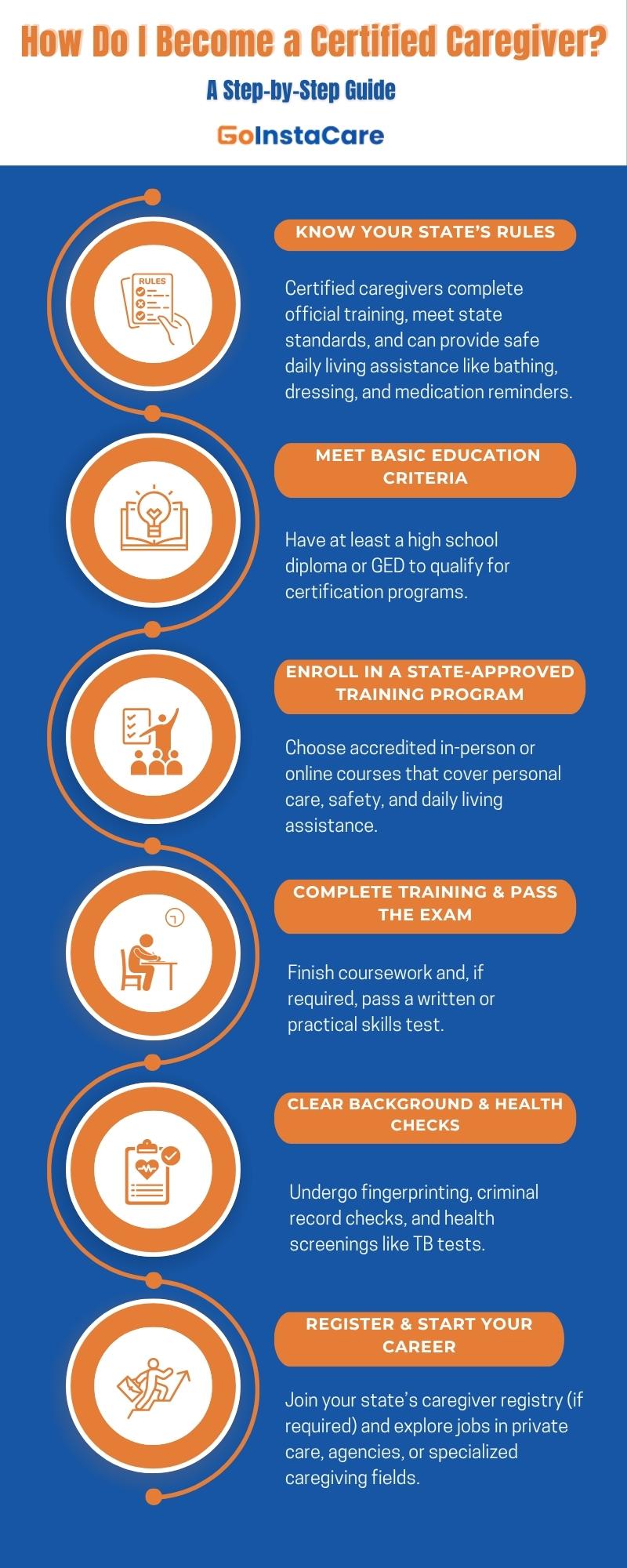
Meet minimum education requirements: Most caregiver certification programs require you to have at least a high school diploma or GED to sign up.
Choose a state-approved caregiver training program: Look for courses offered by accredited online schools, hospitals, or community institutions.
Complete the required coursework: Common subjects include personal care (bathing, dressing), safety, emergency procedures, infection control, communication skills, and help with daily activities (ADLs).
Pass the certification exam: Some states require you to take a written or practical test to see how much you know. If you pass this, it shows you are ready to give care safely.
Review background check and health screenings: These include the caregiver's fingerprints, criminal records, as well as TB or immunization tests to make sure the person receiving care is safe.
Register your state's caregiver enrollment: After acquiring certification, many places require caregivers to submit their information in a public database, especially if they work for an agency or Medicaid.
There are many practical ways to get to classes for caregiver certification. Community colleges and vocational schools often provide in-person training programs that meet state caregiving requirements. These classes, which cover nutrition, infection control, mobility support, and personal hygiene help, typically include classroom lessons and hands-on skills laboratories.
Online caregiver classes are a good option for balancing job and family responsibilities. There are a variety of state-approved online platforms that offers complete certified programs. These include video modules and printed certifications. These programs follow the same curriculum as traditional classroom training, including practice tests for certification exams. It's essential to check that your state approves the online provider before you sign up.
Many assisted living facilities and home care providers offer training paid for by the employer. These programs often give new employees free or low-cost certification as part of their onboarding process. This is an excellent choice if you want to start working immediately and learn while doing it. It doesn't matter if you choose employer-based training or online courses; choosing a program might work with your schedule and state's caregiving requirements.
It won't take long to become a registered caregiver, but it depends on the state and the type of training. Most programs take time to complete from one week to three months. Some courses divide up classes over the weekends or at night to fit with work schedules, but most shorter courses are full-time and quite demanding. If you sign up through an agency, on-the-job training may help you finish employer-led training even faster.
Prices are also very different. Online certification courses can cost between $200 and $600, while community college programs that meet in person typically cost between $500 and $1,000. The price depends on how long the course is, what materials are used, how much the exam costs, and whether or not it includes CPR/first aid certification.
If money is a problem, you can often get help with it. Some states give out training vouchers through workforce development boards or Medicaid-related programs. After you get a job, agencies may also pay for the costs of getting certified. Always ask about grants, scholarships, and payment plans as you consider your options. Getting certified is a short-term investment that pays off in the long run.
Private care, hospice, assisted living, and home care agencies hire certified caregivers. You may aid those recovering from surgery, older people, or people with disabilities. The level of care and cost changes based on the situation of the individual.
Full-time vs. part-time work is flexible depending on your goals. Part-time work is excellent for people who have to care for their family. Full-time care sometimes comes with benefits like health insurance or paid time off.
Specialization opportunities can help you in your career and earn more money.
Dementia care involves focused training on memory support and behavioural management.
Hospice care teaches you to support end-of-life comfort and emotional well-being.
Pediatric care prepares you to work with children with developmental or physical challenges.
You have to complete high school education, a state-approved training program, clear background checks, and in some places, you should have first aid certification to become a registered caregiver.
Yes, you can complete state-approved online training programs to earn your certification as a caregiver. Exams, which cover fundamental abilities, are frequently included in these courses. To guarantee eligibility, be sure your state allows online certification before enrolling.
Caregiver certification can take anywhere from one week to three months, depending on the state regulations and the type of training. Part-time or evening classes can run for a few weeks, but intensive programs terminate quickly.
Getting trained to become a certified caregiver costs between $200 and $1,000. The price depends on how long the course is, where it is held, how the training is done, and whether or not extra expenditures like CPR certification or test fees are included.
No, not every state in the U.S. requires caregivers to be certified. Some states allow unlicensed care for private clients, while others require training for workers in agencies or facilities. Always check the rules for caretakers in your state.
Getting certified to be a caregiver gives you a profession that is both rewarding and flexible, and that helps people. Getting certified not only makes you a better caregiver, but it also makes you more trustworthy with families. It is essential for getting a high salary in specialist fields like paediatrics, hospice, or dementia care. Certification gives you the confidence to succeed, whether starting from scratch. GoInstaCare is there for you when you need it most, whether you want to learn more about certified caregiving or need instant, professional care for your loved ones.
Cities
Houston
Dallas
Austin
San Antonio
Miami
Chicago
Find Here
Companies