
August 11, 2025 • 6 min read

Table of Content
The maximum number of caregivers allowed each patient in assisted living differs from state, the size of the facility, and the specific requirements of the patients. Most assisted living facilities keep an eye on the caregivers to make sure that patients get immediate care. However, several states suggest or require ratios like one caregiver for every six to ten residents during the day and less staff at night. Each person in memory care facilities and other areas needs extra care usually has more than one caregiver. Families can use these ratios to find the best home for their loved ones that impacts the right balance between safety, comfort, and specialized care.
The caregiver-to-resident ratio directly affects the level of care that residents in assisted living get. A smaller ratio implies that caregivers can spend more time with each person. This makes the caregivers and residents closer, helps with everyday tasks, and makes it easier for caregivers to respond to requirements.
This ratio also affects how much personal attention each person gets. When fewer residents per caregiver, there are more chances for emotional support, meaningful connections, and personalized care plans that consider each resident's individual health and lifestyle needs.
Safety, cleanliness, and mental health are also linked to having the correct number of staff. A good caregiver presence guarantees a friendly environment that makes people feel safe and comfortable, regular hygiene practices, and quick help in an emergency.
The typical number of caregivers for assisted living homes daily is about one for every 15 to 20 residents. This may not give each patient exceptionally personalized care, but it lets staff aid with daily duties, remind patients to take their medications, and keep an eye on them.
At night, the number of staff members often decreases, perhaps to one caregiver for every 30 or more residents. This is because most people sleep; therefore, emergency reaction and safety monitoring are more important than active help.
In memory care institutions, there are usually fewer caregivers for each resident, usually between 1:5 and 1:8. People with dementia or Alzheimer's disease have different demands, thus these places need extra care, specialized contact, and closer supervision.
Not every state has laws that specify the exact caregiver-to-resident ratios in assisted living facilities. Most of the time, rules say staffing must be "sufficient for residents' needs." It's up to each facility to figure out what that means. This means that the quality and availability of care vary a lot from one community to another.
California, for instance, sets staffing levels sufficient to satisfy resident needs, although it does not supply particular amounts. Florida law says that institutions must always have at least one staff member on duty. The number of staff members must grow as the number of residents grows. Texas also uses a needs-based norm, which implies that the number of caregivers is based on the residents' health and care needs rather than a predefined ratio.
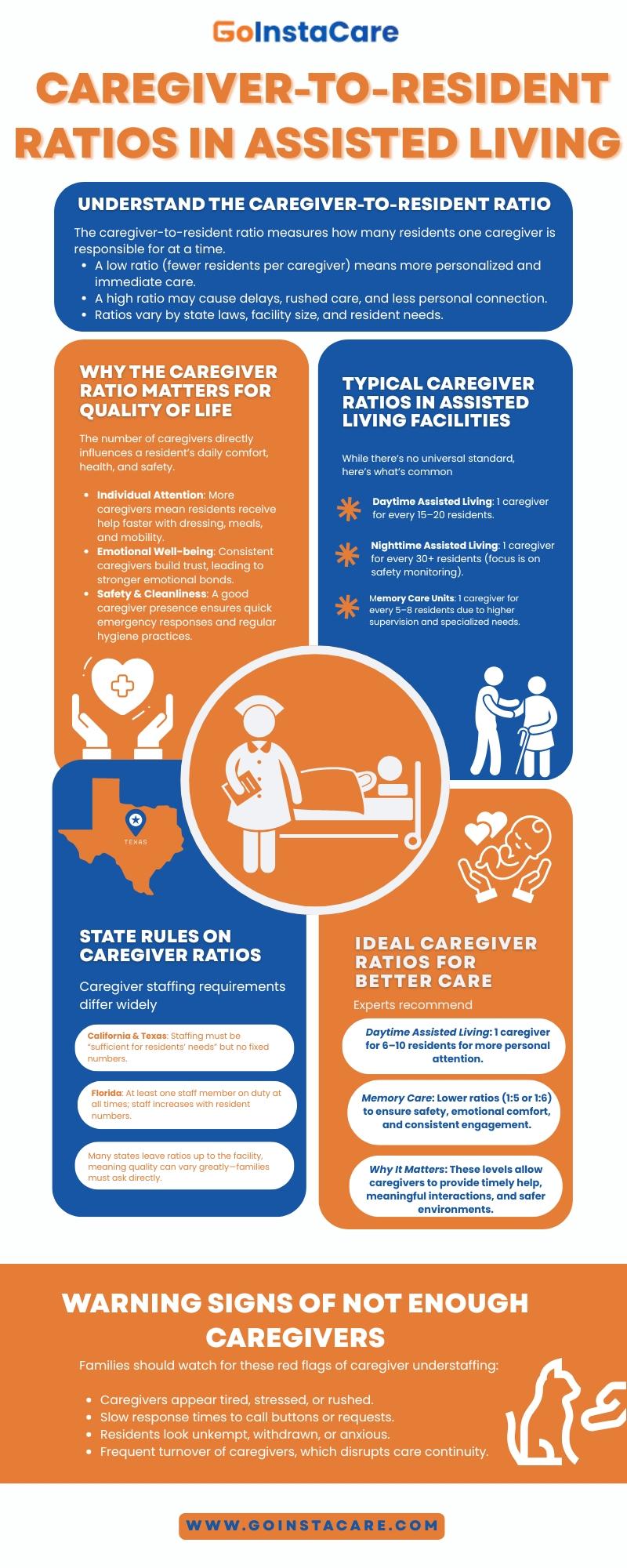
Many experts say there should be one caregiver for every six to ten residents in assisted living facilities during the day. This kind lets caregivers stay in close touch, gives residents a sense of personal attention, and lets them immediately get help with everyday tasks.
Lower ratios often lead to stronger relationships between residents and caregivers, faster response times, and better emotional support. These lower ratios may be needed for comfort and safety in high-need or memory care settings.
Families should be careful around places that don't have enough staff. There may be signs that the ratio is too high for good care, like tired caregivers, rushed exchanges, or help that takes too long to arrive.
The number of caregivers assigned to each shift depends on the facility's size, the residents' requirements, and the time of day. Fewer caretakers may be on duty during night shifts, but there are usually more workers during the day.
The staff turnover rate shows how often caregivers leave and are replaced. High turnover can hurt relationships between residents, make it harder to provide consistent care, and be a symptom of staffing issues or unhappiness at work.
Some assisted living facilities hire part-time contractors or on-call workers to fill gaps in their schedules. This ensures that there is always someone around to help, but it also makes it harder for residents and caregivers to build strong, lasting connections and make care less consistent.
There isn't always a registered nurse at assisted living facilities. If your loved one needs medical care regularly or immediately, it's essential to ensure that nurses are available, as some rely on on-call nurses.
Home help care is a good alternative to assisted living since it gives you personalized, one-on-one aid in a place you know. This strategy ensures that caregivers may focus only on one client's needs, which means they will get full attention and personalized help.
It also allows you to choose your hours based on your needs, medical appointments, or daily routines. Families can choose their caregiver, which helps them find someone who matches their personality, skills, and cultural background well.
Learn more about choosing the best home assistance care in the US to ensure your loved one gets the right amount of comfort, safety, and professional help.
During the day, there are usually 1 to 15 to 20 caregivers for every patient in assisted living. At night, there are fewer staff members. Memory care institutions often have lower ratios, usually between 1:5 and 1:8.
The ratio of caregivers in long-term care is significant because it affects mental health, safety, personal attention, and how quickly people respond. Lower ratios provide more personalized help, stronger relationships, and better overall care for people living in assisted living facilities.
Memory care units frequently include fewer staff members (1:5 to 1:8) to better meet the requirements of patients with dementia or Alzheimer's who need more help and supervision. This ensures that everyone is safe, gets emotional support, and gets personalized daily care.
Not all states require specific caregiver-to-resident ratios for assisted living. Many places say that there needs to be "enough" staff to suit the needs of the residents. This gives a lot of leeway for differences between institutions. Florida, Texas, Virginia, and California are examples of states that adopt this flexible method without predetermined percentages.
Yes, because in-home support is flexible, lets people choose their schedules, and gives them one-on-one attention, it can be better care for some people. It allows caregivers to focus entirely on one person's needs in a comfortable, familiar environment.
The correct number of caregivers for each person can directly affect their comfort, safety, and quality of life. Before choosing an assisted living facility, be sure to ask about staffing, schedule, and the availability of caregivers. If you want your loved ones to get the greatest possible committed help in a comfortable setting, think about GoInstaCare's Instant Quality Care.
Cities
Houston
Dallas
Austin
San Antonio
Miami
Chicago
Find Here
Companies