
December 04, 2025 • 7 min read

Table of Content
At seven in the morning, parents are rushing into any daycare with sleepy toddlers who haven't woken up yet. By 6 PM, the same kids will be tired and sagging, even though their natural cycles have calmed down. The schedule doesn't take into account the child's biological needs; it only takes into account the workday. This arrangement presents a dilemma that nearly all parents contemplate: is child care intended to assist working people who must depend on the system, or is it meant to benefit children? Families deal with this dilemma every day as they try to balance need, guilt, and responsibility; there is no easy answer.
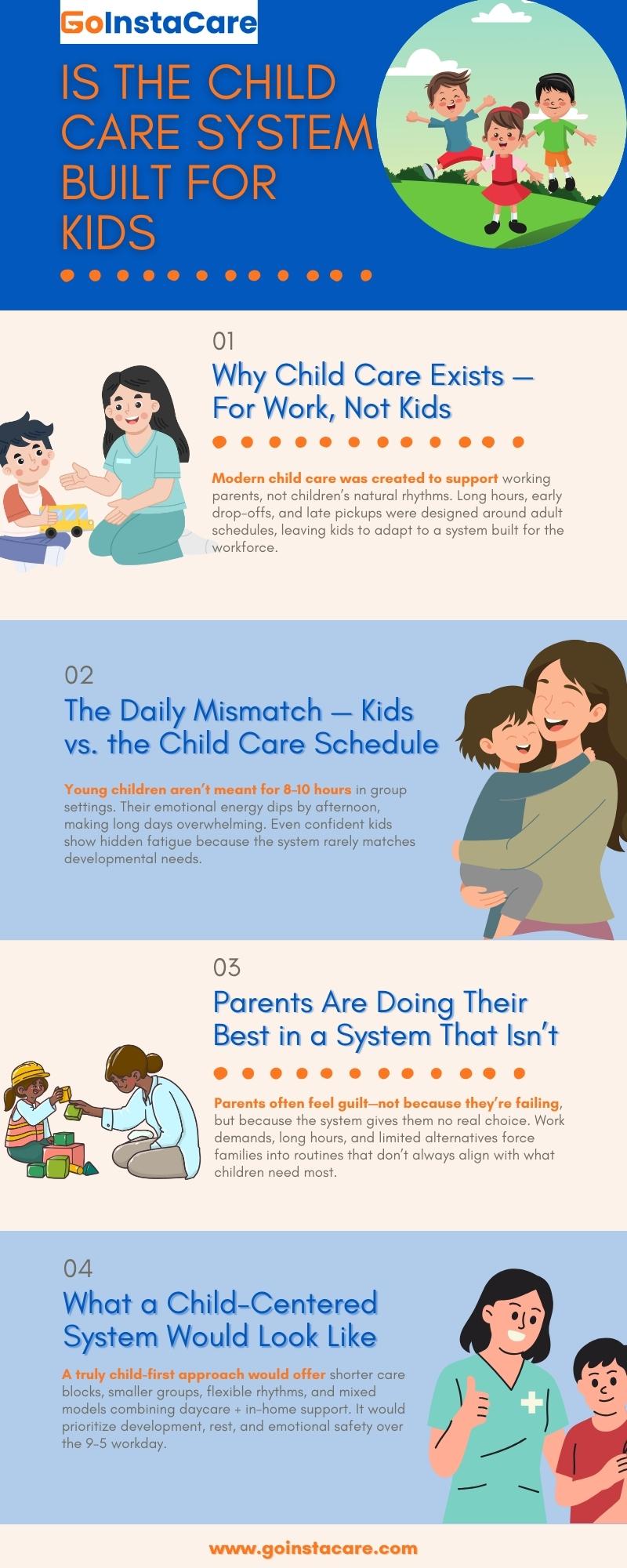
Child care was not initially intended as a model of child development. As families were forced into increasingly demanding routines due to social and economic changes, it developed as a support system for labor. As the number of dual-income homes increased, two working parents were no longer the exception but the rule. Families need long hours, dependable supervision, and regimented spaces that complement work schedules. Child care became the link that allowed for employment.
Soon, the economy was reliant on working parents, which meant that care had to be easily accessible. Long daycare hours became more necessary as industries flourished and expectations rose. Economic demand influenced policy decisions. Infants and toddlers were placed in care earlier than was optimum since parental leave was still insufficient, frequently too brief to be justified by child development studies. The system was largely created to accommodate adult schedules rather than the requirements of children. Families still face difficulties because of this origin.
When you compare a child's natural rhythms to a typical daycare day, you can see the difference. Kids aren't meant to be in a group for 10 hours at a time. Their emotional capacity is at its peak in the morning, and by mid-afternoon, many people feel too aroused or tired. But the system says kids have to stay until their parents get off work.
Kids who need quiet time, one-on-one care, or a slower pace may feel overwhelmed in big groups. Even kids who are confident and outgoing feel stressed from early in the morning until late at night because of all the noise, changes, and demands. Teachers work hard, but it's hard to give each student the aid they need when there aren't enough staff members. Because parents already have to deal with the system's needs, these truths are not often talked about in public. The emotional turmoil comes from knowing that kids adapt but also have a buried tiredness that adults might not always see.
This difference has a major effect on parents. A lot of parents feel awful about dropping their kids early and getting them up late even if they are doing everything they can to keep their family together. Long hours are necessary because of employment and money concerns. Parents still feel like they have to make an emotional bargain even when they know their child is secure and learning.
Families don't have many options with the system so they normally work within its boundaries. Parents may need more specialized care, flexible schedules but their options are limited by cost and availability. The emotional weight does not suggest parental failure. It reveals that the system was developed because it was needed not because it was founded in childhood.
Even while there are problems with child care, it is still a place where many kids learn, grow, and thrive. Early on, good programs allow kids the chance to grow socially, emotionally, and linguistically. They also give them routines that they adore. Caring teachers establish warm relationships that help kids feel confident and curious early on. Many kids spend so much time at daycare that it becomes their second home. There, they learn how to talk to others, share, adapt, and explore their surroundings.
But not everyone had this experience. Some programs don't have professional help, have more students per teacher, or have fewer resources. Some places make it easier to see when someone is overstimulated or emotionally drained. Kids who need more quiet time, personal confidence, or a slower pace may have a hard time without regular one-on-one attention. The benefits are still there, but they vary a lot depending on the center, the teachers, and how well the system can meet different developmental needs. The question is not whether child care can be enriching, but whether the framework always lets enrichment go beyond exhaustion.
GoInstaCare says that families shouldn't have to make emotional concessions because the child care system should help both parents and kids equally. Care shouldn't make you feel like you have to choose between staying alive and growing. RAMA helps families discover caregivers who understand their parenting style, cultural needs, and emotional needs, as well as the stages of childhood.
GoInstaCare says that verified caregivers give you peace of mind because they value developmental pace, stable routines, and consistent emotional support. Families have more options with instant care than they have with traditional child care places. The goal is not to replace the daycare system, but to add more personalized, child-centered care that fits the needs of real families.
A child-centered approach would start by acknowledging the natural limitations of young children, rather than concentrating on the expectations placed on adults. Instead of making kids work full-time, it would offer them shorter care blocks that are more in accordance with how long they can do it. Parents would be able to grasp each child's needs better, stay calm, and become closer to them if there were smaller groups. Mixed-care models might blend parent-supported routines, home care, and childcare to give kids a balance instead of having them spend a lot of time in one place.
Instead of strict time restrictions, kids would have flexible timetables that enable them to relax, play by themselves, or change at their own pace. National measures that give families more time off, flexible work hours, and financial help would make being a parent a top priority. A truly kid-centered society would not be based on the clock-in, clock-out lifestyle that many adults can't give up. Instead, it would be based on studies on child development and emotional reality.
Parents can still find balance, even though the system has its limits. The first step is to pay attention to emotional cues instead of assuming that being adaptable means being comfortable. Kids show what they need by how they act, how much energy they have, and how they feel. Parents can change their routines to encourage quiet, rest, or connection after hard days of taking care of their kids by paying attention to these indications.
Choosing settings that match the child's energy level might make a big difference. Some kids do well in schools that are busy and strict, while others need slower, more relaxed environments. Families can ease emotional stress by combining childcare with in-home care, giving kids places to relax and reconnect. Being consistent is more important than being perfect. A child can handle structured settings better if they feel safe and secure at home. The system doesn't need to be fixed; parents need to learn how to read their child's cues and set up a routine that helps them connect, feel safe, and be strong.
The system is mostly for adults who work, but many programs do their best to address the needs of children as they grow. The balance changes depending on where you are, what resources you have, and how much help your staff can give you.
A lot of kids adjust well, but long hours can make them tired or too excited. Emotional patterns at home can often show how the youngster is doing.
Parents may assess if the classroom is a good fit for their child by seeing how teachers interact with students, how they respond to each child, and the overall mood of the room.
Shorter hours, smaller groups, flexible schedules, and caregivers who are always there would better support the emotional and developmental rhythms of children.
Every day, kids live in the child care system, even though the institution has to deal with adult schedules, money problems, and societal norms. They should get care that is focused on helping them grow, not just what they need. Families are doing their best in a broken system, and their efforts show love, not failure. To make real change, you have to accept that every child has their own rhythm and should be treated with respect.
Cities
Houston
Dallas
Austin
San Antonio
Miami
Chicago
Find Here