
August 12, 2025 • 6 min read

Table of Content
In Georgia, family caregivers can receive payment through programs like Medicaid's Structured Family Caregiving and Community Care Services Program. These programs often give caregivers a monthly stipend that ranges from about $500 to more than $1,200, depending on how much care is needed, how close the caregiver is to the person getting care, and the rules on how the program is funded. Payments may vary from county to county or agency to agency, and they are not set statewide. Most of the time, the person receiving care must meet financial and medical standards to be eligible. The caregiver must live with the person and help them daily instead of hiring a professional.
In Georgia, several Medicaid waiver programs help older folks and people with disabilities stay in their own homes instead of going to a nursing home. Family members who help care for these people might get paid for their work. The two main options are the Service Options Using Resources in a Community Environment (SOURCE) program and the Community Care Services Program (CCSP). These programs help people with personal care, meal preparation, medicine reminders, and mobility by providing Medicaid-funded in-home care.
The CCSP is excellent for people who require care at home but don't want to go to a nursing facility. It can pay for meals delivered to your home, personal support services in your home, and adult day health care. Caregivers, including some family members, may be paid if they meet the program's conditions.
SOURCE offers a better way to coordinate care for people who are elderly, disabled, or have long-term health problems. It includes medical supervision in addition to home care, which makes sure that patients get timely medical care and regular checkups.
The Consumer-Directed Care (CDC) model in Georgia gives people access to CCSP and SOURCE. In this model, the "employer" is a qualified participant or their representatives who can choose and supervise their caretakers, including some family members. This allows for personalized care because family members who know the recipient's needs can provide daily support in exchange for cash. The CDC strategy lets families retain caring for their loved ones at home while remaining financially stable. However, it also means following Medicaid rules, keeping track of timesheets, and ensuring quality care.
In Georgia, Medicaid waiver programs usually pay family caregivers between $10 and $15 an hour. The actual price depends on the program, where the care user lives, and the needs of the care user. A caregiver who works 20 hours a week at $12 an hour would make about $240 a week, or roughly $960 a month. A full-time caregiver who works 40 hours a week could make between $1,600 and $2,400 a month.
Most of the time, approved fiscal intermediaries are responsible for the reimbursement models to make these payments. This makes things easier for the caregiver and the care recipient's family while ensuring wages align with Medicaid and state labor standards.
Due to differences in program funding across the state, caregivers may obtain somewhat higher or lower rates in some counties, and payment periods may differ. Also, in some Medicaid models, such as Consumer-Directed Care, the family may be able to choose hourly wages within the range that the state approves. Because of this flexibility, caregivers can negotiate fair compensation rates for their skills and the level of care they provide. This way, both sides get what they want while following the program's rules.
In Georgia, you can only get paid as a family caregiver if you take care of a Medicaid-eligible individual who is in a home-and-community-based services program like CCSP or SOURCE every day. The person getting care must meet Medicaid's medical and financial requirements. These people usually needs help with everyday things like getting dressed and taking a bath.
Most Medicaid programs will pay for adult children, siblings, and other family members who are wished to be caregivers. One of their program is that the caregiver must live with the patient or they should travel with them.
All potential caregivers must also complete the required training specified by the agency in charge and pass the relevant background checks to ensure everyone is safe. This process ensures caregivers are ready to meet the program's standards for in-home care and provide high-quality support.
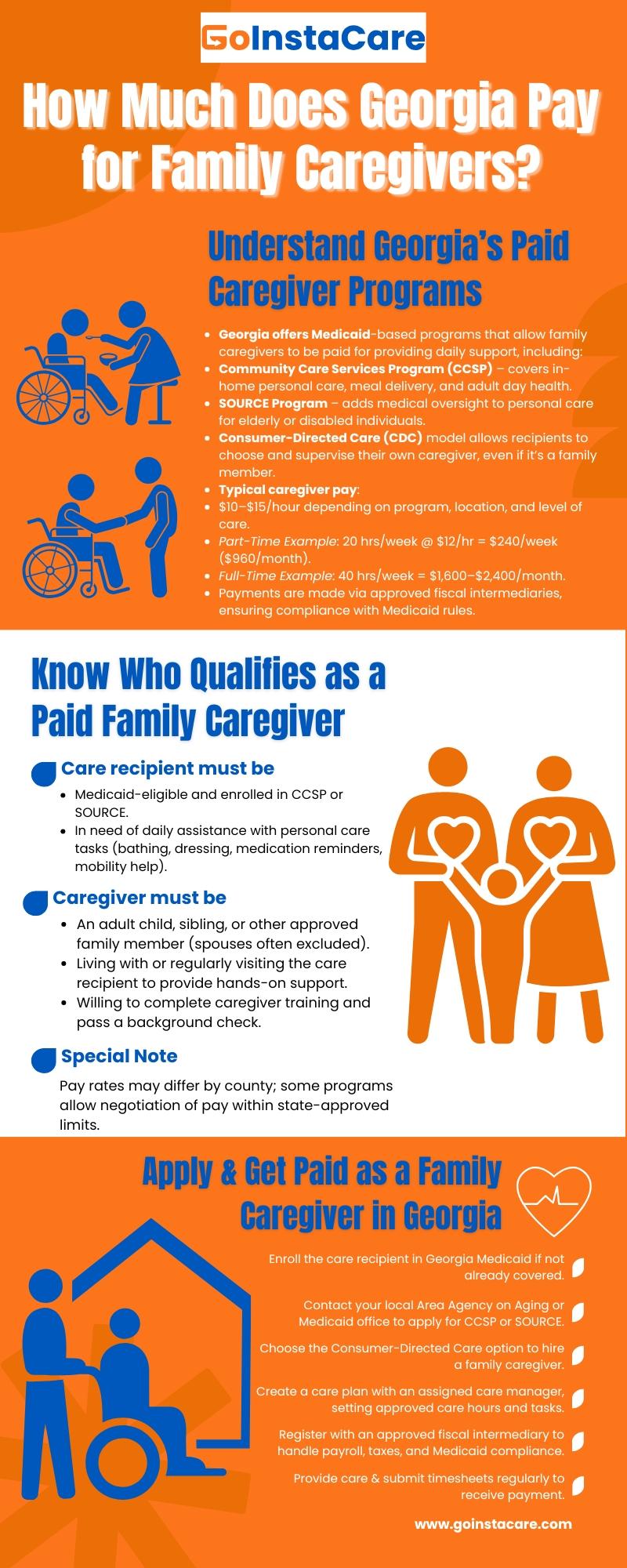
Enroll the care recipient in Georgia Medicaid if they are not already covered, ensuring they meet medical and financial eligibility requirements.
Request in-home care services through the Community Care Services Program (CCSP) or the SOURCE program by contacting your local Area Agency on Aging or Medicaid office.
Select the self-directed or Consumer-Directed Care option within the chosen program to allow a family member to be hired and paid as the caregiver.
Work with an assigned care manager to develop a care plan, determine approved care hours, and complete necessary caregiver enrollment steps.
Coordinate with an approved fiscal intermediary to handle payroll, taxes, timesheets, and ongoing compliance with Medicaid program rules.
Allows care recipients to remain in the comfort of their own home instead of moving into nursing facilities, supporting independence and emotional well-being.
Provides financial assistance to help low-income families offset lost wages when a family member reduces work hours or leaves a job to provide care.
Offers a flexible schedule that can be adapted to the family's routine, ensuring care is delivered in a familiar and supportive environment.
It is easier for families in Georgia to find certified and licensed caregivers who understand the specific requirements of GoInstaCare. You can get full-time or part-time care with Instant Quality Care for your loved ones . Find Best Family Caregivers in the USA is another choice for reliable possibilities. It can help families across the country to find caregivers more quickly and easily.
In Georgia, Medicaid programs like CCSP, SOURCE, or the Consumer-Directed Care option can pay a family member to care for someone if the caregiver and the recipient match the qualifying requirements.
Georgia Medicaid programs that pay family caregivers include the Community Care Services Program (CCSP), SOURCE, and the Consumer-Directed Care option. The latter allows qualified participants to hire and pay certain family members for providing permitted in-home care services.
The average cost of Medicaid programs in Georgia offers family caregivers between $10 and $15 per hour. Their prices may differ because of their location and the experience of the caregiver.
To guarantee that paid family caregivers can deliver safe, efficient in-home care that satisfies program and state quality requirements, most Georgia Medicaid programs require them to complete basic training and pass background checks.
Suppose you want to be a paid caregiver for a parent in Georgia. In that case, you must ensure the parent is eligible for Medicaid, ask for CCSP or SOURCE services, choose the self-directed option, and complete the enrollment procedure.
Medicaid programs in Georgia that include CCSP, SOURCE, and Consumer-Directed Care helps family caregivers and give them expenditures. This makes it easier for families to care for their loved ones at home and reduces the expense of care. Knowing the possibilities and the requirements for qualifying will help you deal with the stress of caregiving, both financially and emotionally, so that you can keep doing it. GoInstaCare makes it easy for families to discover qualified caregivers. This helps families get high-quality care.
Cities
Houston
Dallas
Austin
San Antonio
Miami
Chicago
Find Here
Companies