
September 08, 2025 • 6 min read

Table of Content
Families that offer safety and value when they compare LTC coverage. An independent long-term care policy is an individual plan that only pays for long-term care costs, like nursing homes, assisted living facilities, or aid at home. An LTC rider is an extra benefit that can be added to a life insurance or annuity policy. If you need care, you can use part of the benefit to pay for it. Each plan's pros and cons are cost, flexibility, and coverage limits. Families may choose the best option for long-term care planning and financial security.
Long-term care insurance is very important because the expense of caring for seniors always increases. Assisted living and in-home caregiving services cost families thousands of dollars per month. Families have to pay for most long-term personal care because Medicare doesn't cover it.
This is why a lot of families begin to think about long-term care plans when their children are young. They pay less for their costs and have better chances of acquiring coverage if they buy it when they are young and healthy, usually between the ages of 50 and 60. If seniors have long-term care insurance their families can have care they receive. Planning provides you peace of mind that you'll have money and good care when you need it.
A standalone insurance plan developed expressly to satisfy long-term care requirements is an independent LTC policy. This insurance explicitly covers hospice, assisted living, in-home care, and nursing homes, compared to riders added to other policies. It is meant to give families immediate financial support when seniors need medically based long-term care or daily personal assistance that is not covered by Medicare or standard health insurance. It often provides more extensive security than packaged solutions because it stands alone.
Flexibility and wide coverage are two advantages of an individual LTC policy. Families can adjust benefit periods, daily or monthly constraints, and benefit amounts to suit future demands. This lets policyholders plan for different types of care, such as moving into an assisted living facility or staying at home with aid from a caretaker. Seniors are safeguarded from severe gaps because of the emphasis on comprehensive coverage.
But it's important to know what the limits are. Independent LTC insurance rates can be high at times, which makes them more expensive than riders. They also have strict underwriting, which means that people who are older or already sick may not be accepted or may have to pay a lot more. Families need to think about these trade-offs very carefully.
An LTC rider lets families get long-term care coverage without buying a separate plan. It is attached to a life insurance or annuity policy. When help is needed, part of the policy's death benefit can be used to pay for services like assisted living facilities, nursing homes, or in-home care. This plan combines flexibility and financial security to give families a way to meet many needs with just one insurance policy.
The initial benefit of an LTC rider is often that it is affordable. Riders are usually cheaper than buying separate LTC coverage because they are added to an existing life insurance plan. They are also convenient because families don't have to deal with two types of insurance. This may be appealing to people who want a simpler and cheaper choice but still want some long-term care insurance.
However, other rules must be followed. Using the LTC, it reduces the death benefit that individuals receive because the cost of care is removed from the insurance payout. Coverage duration and payout levels are sometimes more limited than those of standalone LTC plans. This might lead to gaps if long-term care needs last for several years. Families need to compare carefully.
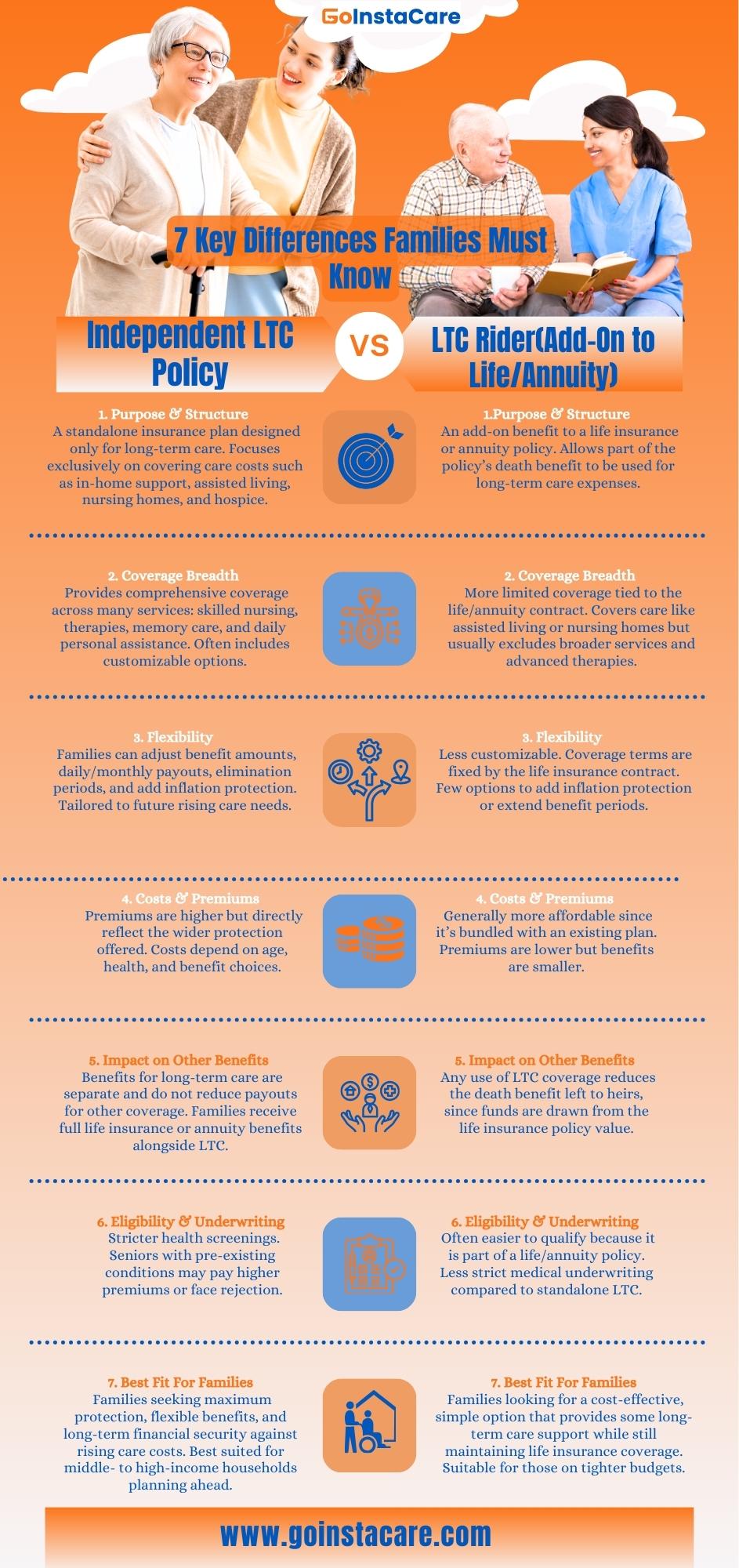
Independent LTC policies usually have higher premiums but offer broader coverage. Riders are more affordable and bundled with life insurance, but the benefits are limited.
Standalone policies cover many services, including extended in-home care, nursing facilities, and therapies. Riders often cap benefits and reduce death payouts when used.
Independent policies allow customization, inflation protection, and more extended benefit periods. Riders are less flexible, with fixed terms tied to the life insurance policy.
Independent policies protect against increasing care costs but demand higher investment. Riders balance affordability with coverage but may not fully safeguard long-term needs.
You need to decide between LTC coverage and supplementary coverage based on your health and medical requirements. Children who are healthy may choose to get their own insurance. It gives them full coverage and allows them to adjust to increase medical expenses. Families who spend a lot of money could also select this approach to keep their finances stable over time.
The biggest difference between a rider and an LTC policy is how much they provide. A rider is less expensive but it doesn't offer as many advantages and often reduces the death benefits of life insurance. An LTC policy gives you greater and flexible coverage.
An LTC rider is typically less expensive than a standalone policy because it includes life insurance. It can, however, lower the total death benefit payout and offer less flexibility and a shorter coverage period.
Most long-term care policies cover caregivers who come to your home to help with everyday tasks and medical care. The terms of the insurance and whether licensed professionals or approved organizations deliver the services all impact coverage.
Most people should buy long-term care insurance between 50 and 60. Currently, candidates are healthier and prices are more reasonable, making eligibility for more complete coverage more straightforward.
It is not always easy but moving from a rider to a standalone insurance policy is possible later. Eligibility restrictions and increased premiums due to health changes could all be part of it.
There is no one-size-fits-all answer to whether to choose a rider or an independent LTC insurance policy. Every family should think about their health and what kind of care they want in the future before making a choice. Families who are concerned about the cost and advantages of their packages might be happier with a rider choice. At the same time, a single policy might be beneficial for families who want insurance that covers everything and gives them additional choices.
Talking about finances with family members and making plans ahead of time could help to avoid unexpected money troubles under all situations. It is still important to get reliable guidance from skilled caregivers while making decisions about insurance. GoInstaCare offers your loved ones quick, high-quality care from senior caregivers who are experienced and trustworthy. They also offer specific support. If seniors have the correct insurance and an experienced caregiver, they can obtain the care they need without causing too much stress on their families.
Cities
Houston
Dallas
Austin
San Antonio
Miami
Chicago
Find Here
Companies