
July 15, 2025 • 7 min read

Table of Content
The exact rate depends on where you live, the care program, and how much help the person getting care needs. Medicaid usually pays caregivers between $10 and $25 an hour. Each state runs Medicaid-funded programs like Consumer Directed Services (CDS) and Home and Community-Based Services (HCBS). They also set the rules for how much caregivers are paid.
Some states, like California and New York, have higher rates because the cost of living is higher there. Medicaid caregiver pay in Texas tends to range lower, usually between $10 and $13 hourly under the state’s HCBS program. Even though Medicaid pay isn't a full-time salary, it can help family caregivers who are providing significant support by making it easier for them to pay their bills.
Yes, Medicaid can pay for caregivers through state-approved in-home care programs. These are Consumer Directed Services (CDS) and Home and Community-Based Services (HCBS). They allow qualified caregivers and sometimes even family members. However, each state runs these programs in its own way, with different rules for who can get them and how much they pay. In some states, spouses or adult children get paid, but not in others. The amount depends on the kind of care needed, the hours approved, and the cost of living in the area. Because of this, the pay for Medicaid caregivers is very different in different parts of the country.
Medicaid has programs that help people get care at home instead of in a nursing home. Some of these programs pay family members to care for their loved ones.
These are the main ones:
Consumer-directed services (CDS): Let the person getting care choose their caregiver, often a family member. They have the power to hire people and tell them what to do.
Home and Community-Based Services (HCBS) Waivers: These programs help people at home with things like cleaning, personal care, or cooking. Some states allow family members to work as caregivers.
Structured Family Caregiving: If you live with the person you care for, this program may pay you a daily price to help and give them extra help.
Family caregivers can get paid through these programs in states like New York, California, Pennsylvania, and Colorado. However, the laws in each state are different. Always check your state's Medicaid program for details.
The average pay for caregivers on Medicaid ranges from $10 to $25 per hour, depending on several factors. State Medicaid funding is a big part of it. For example, Florida SMMC long-term care caregiver pay usually ranges from $11 to $17, depending on the region and care level approved.
The hourly price may change based on whether the caregiver is a family member or a trained professional. Some states only allow family members to do basic personal care, even though professionals may do more. Many programs also have hourly caps, which limit how many hours a caregiver can be paid for in a week or month.
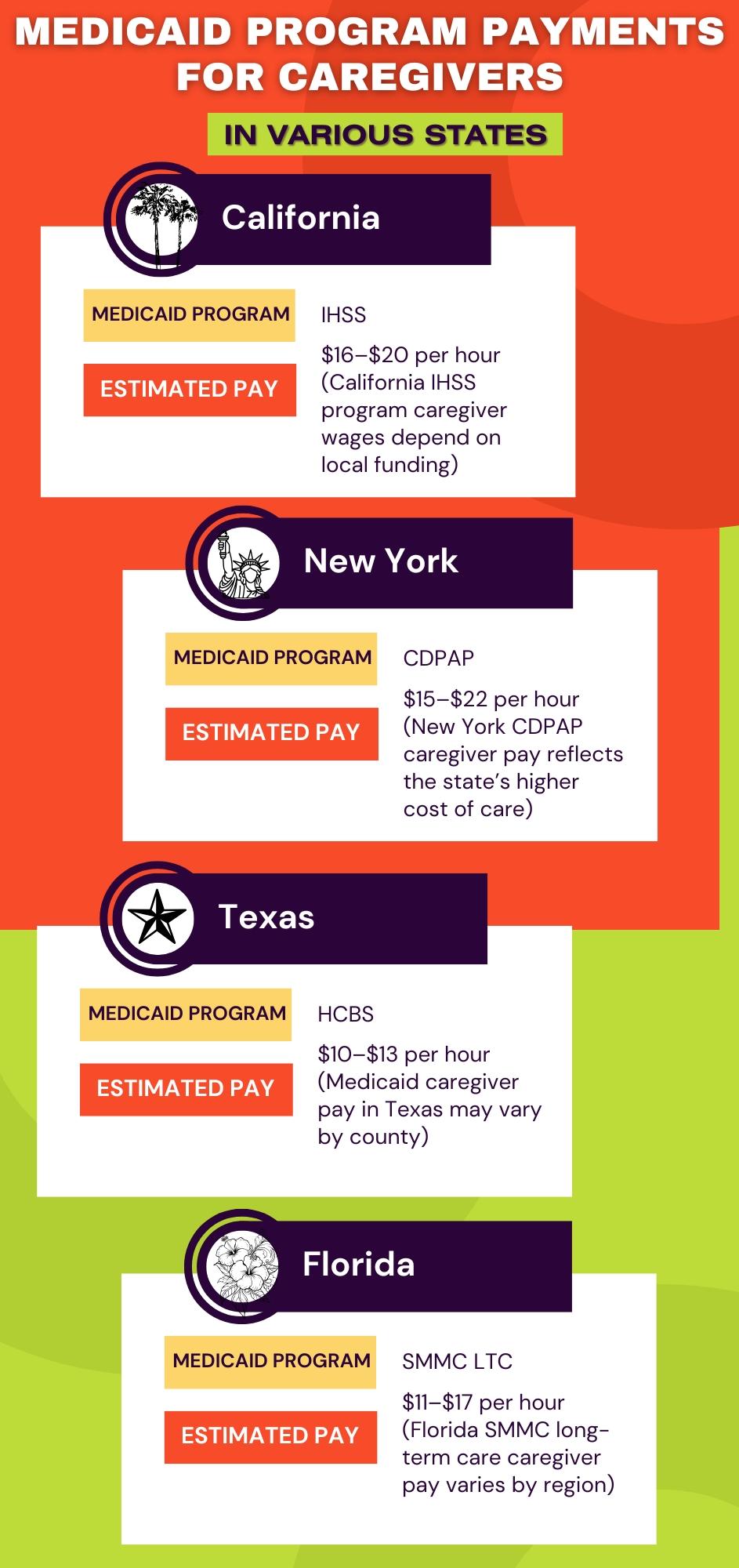
Here is a brief overview of the potential Medicaid program payments for caregivers in various states. Remember that these are approximations and may differ depending on the county, authorized hours, and level of care required.
State | Medicaid Program | Estimated Pay |
California | IHSS | $16–$20 per hour (California IHSS program caregiver wages depend on local funding) |
New York | CDPAP | $15–$22 per hour (New York CDPAP caregiver pay reflects the state’s higher cost of care) |
Texas | HCBS | $10–$13 per hour (Medicaid caregiver pay in Texas may vary by county) |
Florida | SMMC LTC | $11–$17 per hour (Florida SMMC long-term care caregiver pay varies by region) |
In many states, Medicaid pays family caregivers through waiver programs like CDS. Each state sets its own rules for who qualifies and how much they get paid. In many states, people can choose their caregiver through Consumer-Directed Services (CDS) or other self-directed models. This allows them to hire a trustworthy family member to help around the house daily.
However, not every family member is always fit for the job. In some states, conflict-of-interest laws say that spouses can't work as paid caregivers. In other cases, parents of minor children are also not allowed. Most programs would rather have adult children, siblings, or other family members take care of them. Medicaid caregiver pay depends on state-approved care plans, especially for family caregivers hired through CDS or HCBS programs. The number of hours that will be paid is determined by a caregiver that considers the person's level of assistance with eating, dressing, and bathing.
So, even though it is an option, it is not a sure thing. To get paid and approved as a family caregiver, you must apply through the right Medicaid program in your state and follow its rules. Always double-check with your state's Medicaid or health office.
To get paid as a caregiver by Medicaid, the caregiver and the person receiving care must undergo an enrollment process. The first step is to check to see if the person who needs care is eligible for Medicaid based on their income, assets, and medical needs. After getting the green light, they have to do a care needs assessment, which is usually done by a nurse or caseworker who will figure out how much help they need every day. If they qualify for in-home care, they can choose a program like Consumer-Directed Services (CDS) or Home and Community-Based Services (HCBS), depending on what is available in their state.
After choosing a program, the agency or financial intermediary in charge of the care must approve the caregiver, often a family member. This could include paperwork, background checks, and some basic training on how to care for someone. Caregivers can start keeping track of their hours and getting paid after everything is done. Your local Medicaid office or Area Agency on Aging will help you with everything from filling out forms to picking a program.
Use your state's portal or health office to apply for Medicaid.
To determine the service level, finish a care needs assessment.
Select an in-home or consumer-directed care program if you are qualified.
Complete training, submit caregiver documentation, and clear background checks.
Once approval has been verified, start recording hours and getting paid.
Medicaid usually pays caregivers between $10 and $25 an hour, depending on the state, the care program, and the type of caregiver. Rates vary greatly; some states have hourly limits, and family caregivers are paid differently than professional caregivers.
California, New York, Texas, Florida, Pennsylvania, and Colorado are some states that use Medicaid programs to pay family caregivers. Each state has its rules, so the names of programs, pay rates, and who can be a caregiver may differ depending on where you live and what kind of care you need.
Yes, in many states, Medicaid will pay you to care for a parent. Parents can select a family caregiver through programs such as Consumer-Directed Services; however, eligibility, compensation, and caregiver approval are contingent upon state regulations and care requirements.
Yes, Medicaid frequently pays family members and professional caregivers differently. Professionals may be paid more because they are certified, but family members may be paid less because of the care plan, relationship, and state regulations, particularly in consumer-directed programs.
Yes, taxes are typically applied to caregiver pay. You may be subject to Social Security and Medicare taxes if you receive income from a Medicaid program or agency. Nevertheless, depending on their relationship and living situation with the care recipient, some family caregivers are eligible for exemptions.
Medicaid caregiver pay ranges from $10 to $25 depending on your state and care plan. Programs like CDS and HCBS let families get compensated for in-home support. To learn how to apply or check local eligibility, revisit the enrollment section above. For help finding support fast, GoInstaCare connects you to trusted care resources. Knowing your state's Medicaid options is essential to getting this assistance, whether you're a professional or a family member. Although helpful, programs like CDS and HCBS can be challenging to navigate. Visit GoInstaCare or talk to a care advisor for assistance if you need it in determining your local options or locating more care support.
Cities
Houston
Dallas
Austin
San Antonio
Miami
Chicago
Find Here
Companies