
August 19, 2025 • 5 min read

Table of Content
Yes, under some Texas programs, a spouse can get paid for taking care of someone else, but this depends on the situation of the person receiving care and the qualifications for the program. Medicaid programs like Community First Choice (CFC) and Home and Community-Based Services (HCBS) will pay spouses who care for someone every day as long as that person meets these services' standards. Veterans' programs may also offer stipends to spouses who care for veterans. On the other hand, most private and employer-based insurance plans do not cover this type of arrangement. To get paid while legally and successfully taking care of your spouse at home, you need to know the specific requirements for the program, how to apply, and what documentation you need.
In Texas, spouses can get paid to be caretakers, but only through specific Medicaid waiver programs. These initiatives are meant to let families choose their caregivers, even if the care recipient is a spouse. But it's not always legal, especially in programs that use an agency-based care model, meaning the caregiver must be paid by and hired through a licensed care agency.
Texas has two main types of care: self-directed care, where the individual getting care (or their agent) picks and supervises their caregiver, and agency-directed care, where the agency handles hiring and payroll. Spousal payment is frequently allowed with the self-directed option because it gives you more control over who provides care.
The spouse must keep tracking their caregiving hours, follow payroll procedures, and complete the program's training or certification requirements in order to be eligible. To get paid as a spousal caregiver in Texas, you first need to decide which program you are applying for and whether it is self-directed.
The Consumer Directed Services (CDS) a chance of the STAR+PLUS Medicaid Waiver is the main program in Texas that allows spouses to receive compensation and to take care of their loved ones. The person who requires care can choose, schedule, and manage their caregivers. This flexibility frequently implies that a spouse who corresponds to the program's qualifications can work as a paid attendant. The CDS choice is a more personalized approach to acquire in-home care that fulfills Medicaid requirements by letting the individual receiving care determine their work tasks and training.
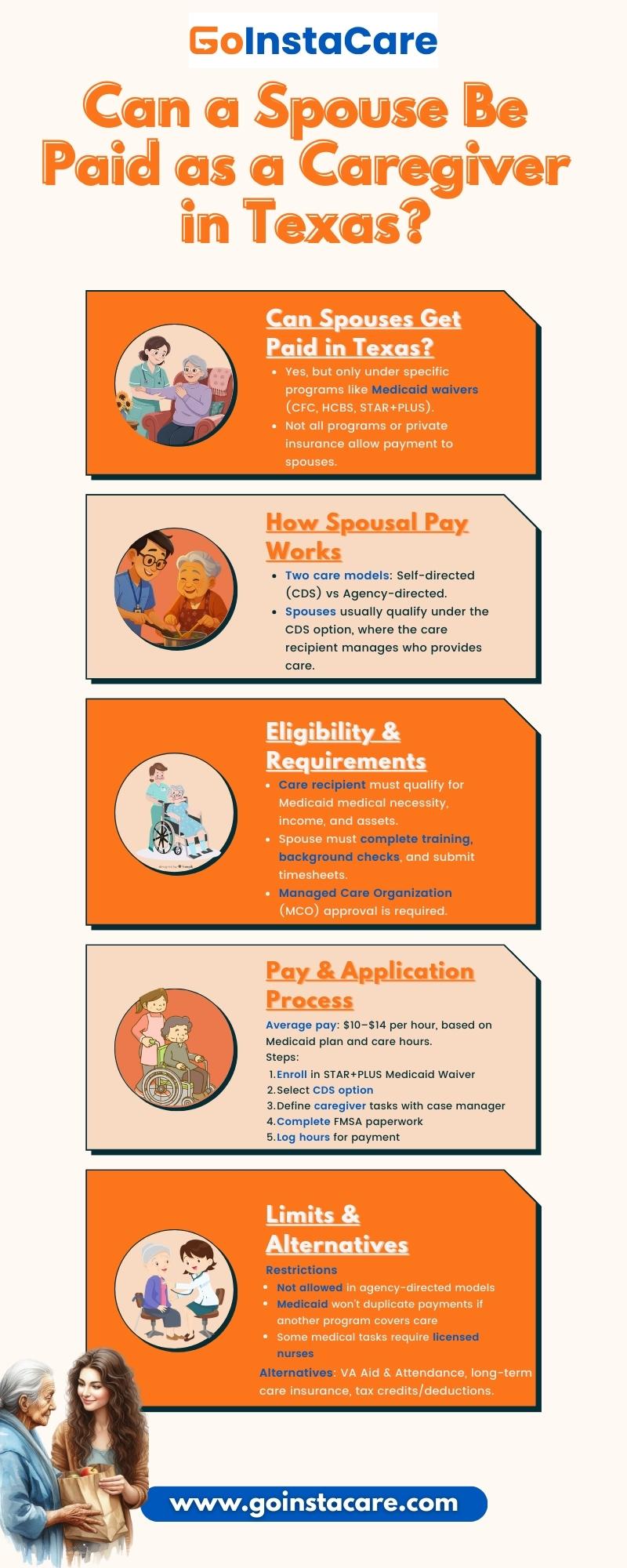
To get paid as a spousal caregiver in Texas, the person receiving care must first be eligible for Medicaid. This means they must meet the state's requirements for medical necessity, income, and assets. The spouse must also complete the required training and turn in the required paperwork, in addition to meeting all job standards stipulated by the chosen program, such as background checks and timesheet reports. The managed care organization (MCO) responsible for the recipient's STAR+PLUS Medicaid Waiver services must also consent to the deal. You can't pay for spousal caregiving without MCO consent, even if all the other prerequisites are met.
In Texas, spouse caregivers typically make between $10 and $14 an hour, although the exact amount depends on where they work and what Medicaid managed care plan they are on. Payments are handled by a Financial Management Services Agency (FMSA), which also keeps track of wages, tax withholdings, and other records. A medical necessity review, which looks at the daily help needs of the person receiving care, decides how many hours a spouse can work. This means that the amount of money paid can vary significantly from case to case, depending on the care plan approved by the program and the level of support.
Enroll the care recipient in the STAR+PLUS Medicaid Waiver program.
Select the Consumer Directed Services (CDS) option during enrollment.
Collaborate with a case manager to define and assign caregiving tasks.
Complete all necessary employment forms through the Financial Management Services Agency (FMSA).
Begin logging and submitting hours worked for payment processing.
Limitation | What It Means |
Spouse may not be eligible in agency-directed care models | Only self-directed programs like CDS allow spousal payment; agency-managed care hires outside workers. |
Can't be paid for services already covered by another party (e.g., VA, insurance) | If another program covers the care, Medicaid will not duplicate payment. |
Specific complex care may require a licensed nurse instead | Medical tasks beyond a spouse's training must be performed by a licensed professional. |
The Aid and Attendance benefit from the Veterans Affairs can help pay for a spouse who is taking care of a qualified veteran. Long-term care insurance policies may include terms that pay caregivers, but only if the plan allows it. Two examples of tax credits and deductions that can help with money problems are deducting eligible medical expenses or claiming a dependent spouse who needs medical care. These choices may be helpful for couples needing help paying for in-home care but who do not qualify for Texas Medicaid programs.
Yes, your spouse can get paid in Texas as a caregiver under some programs, such as the STAR+PLUS Medicaid Waiver under the Consumer Directed Services option, as long as they meet all the eligibility, training, and paperwork requirements.
The STAR+PLUS Medicaid Waiver with the Consumer Directed Services (CDS) option in Texas lets families hire, supervise, and organize care for qualifying loved ones directly by letting spouses function as paid caregivers.
In Texas, spousal caregivers can make between $10 and $14 an hour, depending on the Medicaid plan and where they live. The recipient's evaluated medical and care needs determine how many hours are allowed.
In Texas, Medicaid clients can hire, train, and oversee their caregivers under a Consumer Directed Services (CDS) program. The Financial Management Services Agency takes care of hiring and paying these caregivers.
In Texas, you don't need a professional license to be a paid caregiver for your spouse. However, you need to meet the requirements of the Medicaid program, complete training, and follow the rules for work and documentation set by the care model you choose.
In Texas, there are only a few Medicaid alternatives that allow a spouse to get paid and take care of an individual. One of these is the STAR+PLUS Waiver using the Consumer Directed Services model. Families can hire and guide their caregivers through this program that helps spouses work to take care of loved ones at home. Not all programs pay spouses, so it is essential to confirm eligibility. Even if earnings differ by location, this alternative might help a lot with money problems. GoInstaCare helps families to find trustworthy people that helps more in-home care choices.
Cities
Houston
Dallas
Austin
San Antonio
Miami
Chicago
Find Here
Companies