
July 17, 2025 • 7 min read

Table of Content
Caregivers must tell the IRS about all the money they get from private clients, agencies, or family members. How you report depends on whether you are an employee or self-employed. Because they are considered self-employed, most independent caretakers must file their taxes using Schedule C. If you work for an agency, your boss will provide you with a W-2. If a family pays you directly, they may have to offer you a 1099-NEC. If you disclose your caregiver income correctly, you can get benefits and avoid fines. This video explains the tax laws, forms, and steps you need to take to follow IRS rules.
How you report your caregiver income will differ if you are a household employee or an independent contractor. A household employee works for a family and cares for them in their home. The family is responsible for the work schedule, the duties, and how care is given. In this case, your family is your boss and is responsible for withholding and paying your Social Security, Medicare, and unemployment taxes. They could also have to give you a W-2 form at tax time.
On the other hand, independent contractors usually work for themselves or a home care company. You decide when and how the task gets done. Independent contractors often do their taxes in addition to working for many clients. You can get a 1099-NEC form if you get $600 or more from one client. Even if you don't get a form, you must tell them how much money you make.
The IRS looks at how much influence the payer has over your work. If the person who pays you controls when, how, and how often you work, you are undoubtedly a domestic worker. You are self-employed if you are in charge of your own tools and schedule. Knowing the difference is essential because misclassifying can cause tax problems for both sides.
You are regarded as self-employed as a caregiver if you work for yourself or under agreements with families. You must receive IRS Form 1099-NEC from clients who pay you $600 or more annually. You must still record your earnings even if you have not received this form.
Independent caregivers must maintain accurate records of their earnings and hours worked, including cash, checks, and app payments. This facilitates tax filing and deduction claims. With Form 1040, you will use Schedule C to declare this income and Schedule SE to compute your self-employment tax.
The following typical expenditures can reduce your taxable income
Caregiving supplies like gloves, wipes, or medical kits
Mileage when traveling to clients' homes
Uniforms or clothing required for care duties
Professional training or certification expenses
Home office costs if you manage your services from home
You can lower your debt by keeping track of these costs and preserving your receipts. You should also submit quarterly anticipated tax payments to the IRS to avoid fines, as self-employed caregivers do not have taxes automatically withdrawn.
If you are a caregiver who works directly for a family and has control over your schedule and how you do your job, you are considered a household employee. In this case, your family is your boss and has to give you an IRS Form W-2 showing all of your income and the taxes taken out. They must also send in Schedule H with their tax return to show employment taxes.
Your employer is liable for withholding Social Security, Medicare, and Federal Unemployment Tax (FUTA) if they pay you $2,700 yearly. This will make it easier for you to get Social Security payments in the future. Your income is still taxable even if you don't pay self-employment tax.
If you are a spouse, parent, or child under 21 who works for the family, you may not be classified as a household employee. To avoid making mistakes when paying taxes, the caregiver and family should review the IRS's rules for these ties.
According to IRS Notice 2014-7, some Medicaid waiver payments may not count as income in some cases. If you live with the person you care for, Medicaid waiver payments for personal care services may be considered difficulty-of-care payments and are not taxable. This rule applies even if you get a W-2 or 1099, as long as the care is for someone living in your house.
To qualify for this exception, the person receiving care must live with you full-time, the services must not be medical and must be done under a Medicaid waiver. You don't have to report this income on your taxes, but many individuals do so that they can get earned income credit or other benefits. If Medicaid waiver payments don't fall under the exclusion, you must declare them as income. Depending on how the deal is set up, the IRS may see them as employee pay or self-employment.
Regarding taxes, caregivers frequently make mistakes, particularly if they work for several clients or privately. Penalties or lost benefits may result from these errors.
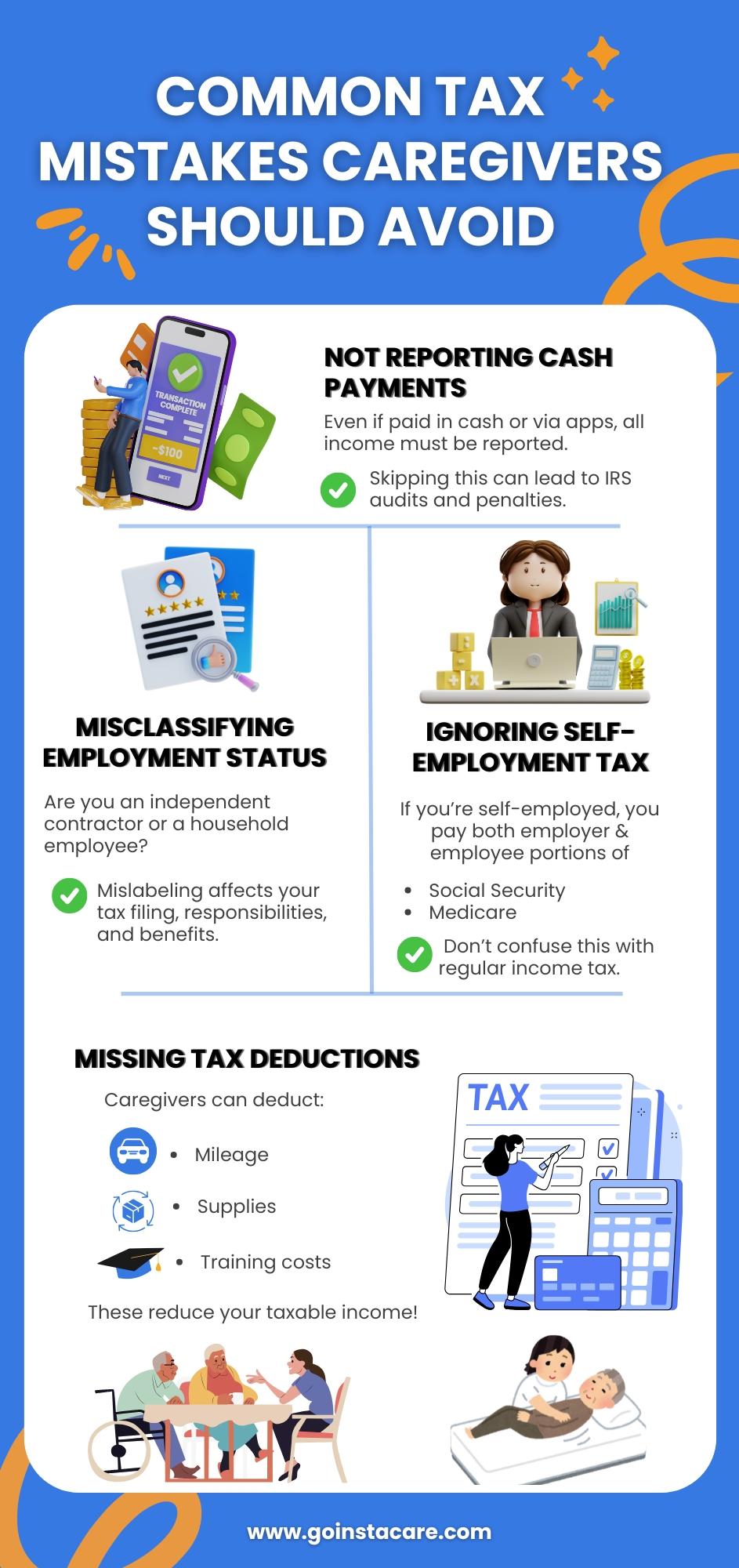
Not reporting cash payments: All income counts, even if paid in cash or through apps. Failing to report it can trigger audits or fines.
Misclassifying employment status: Mixing up whether you're an independent contractor or a household employee affects how you file and what taxes you owe.
Ignoring self-employment tax: Independent caregivers must pay the employer and employee portion of Social Security and Medicare taxes. This is separate from income tax.
Missing out on deductions: Many forget to claim business-related expenses like mileage, supplies, and training. These lower your taxable income and reduce what you owe.
As a caregiver, paying taxes is easier if you plan and get ready. These steps will help you stay within IRS rules and make tax season less stressful.
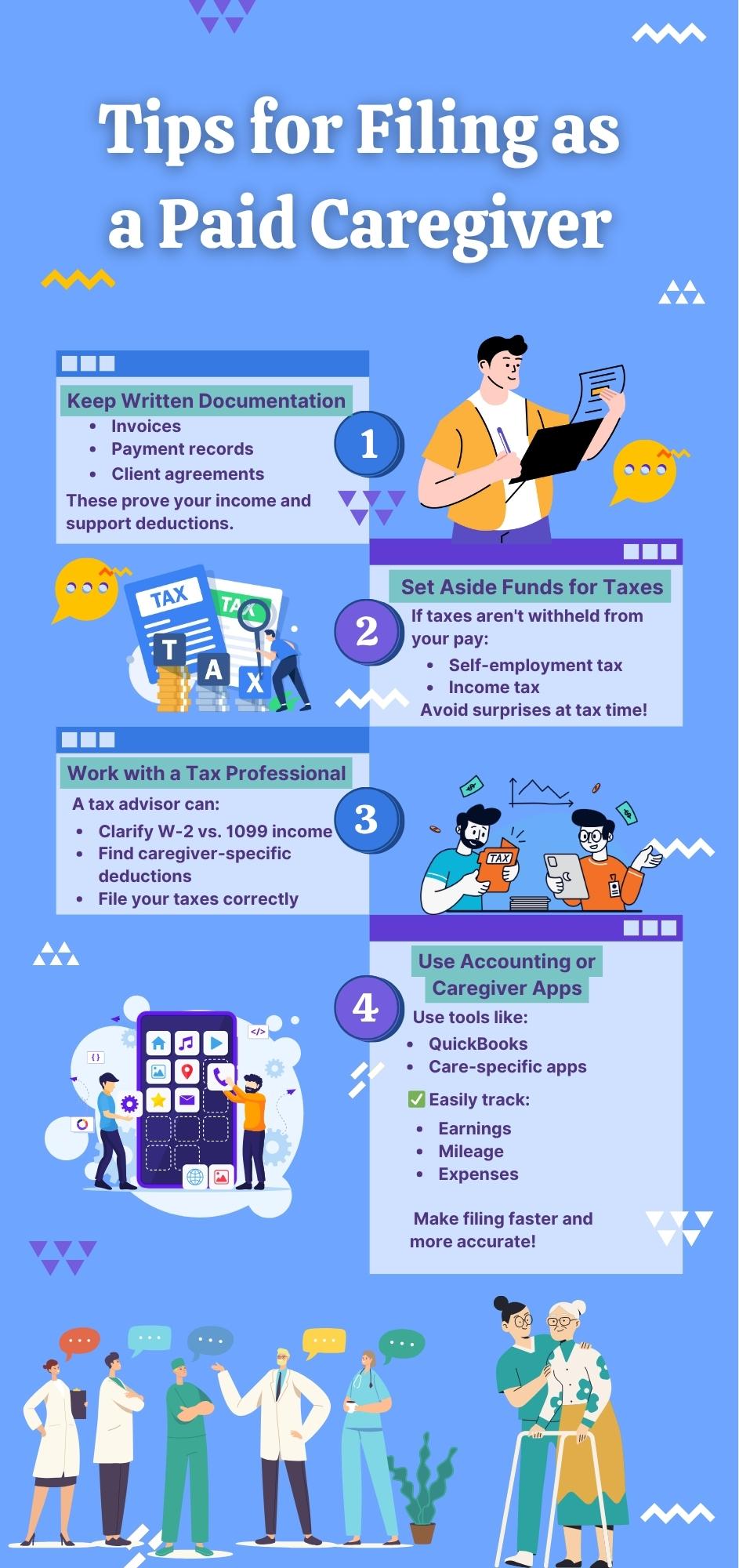
Keep written documentation: Save copies of invoices, payment records, and agreements with clients or families. These serve as proof of income and help justify deductions.
Set aside funds for taxes: If no one withholds taxes from your pay, save a portion of your income regularly to cover self-employment tax and income tax.
Consider working with a tax professional: A tax advisor can help you understand forms, identify deductions, and file correctly, especially if you receive both W-2 and 1099 income.
Use accounting tools or caregiver apps: Tools like QuickBooks or care-specific apps help you track earnings, expenses, and mileage, making tax filing smoother and more accurate.
Yes, you must tell the IRS about your income, even if you get paid under the table. You could get in trouble if you don't record your money profits. Keeping records and filing honestly protects you and ensures you get advantages in the future, including getting Social Security.
Caregivers who work for themselves fill out Schedule C and Schedule SE along with Form 1040. The family gives household staff a W-2. A 1099-NEC is usually given to independent contractors making over $600. Each form depends on your type.
A caregiver may be considered self-employed if they work alone, set their hours, and have more than one client. In this case, they pay self-employment tax on their tax return using Schedule SE and declare their income using Schedule C.
IRS Notice 2014-7 says that Medicaid payments to caregivers who live with the person they are caring for may not be taxed. If the caregiver doesn't live with them or the payments aren't eligible, the income is taxable and must be reported.
If the caregiver is an independent contractor and you paid them less than $600 in a year, you could have to file a 1099-NEC. You must submit a W-2 and adhere to employer tax regulations if the caregiver works for your household.
You need to record caregiver income correctly to stay on schedule with the IRS and keep your eligibility for future benefits like Social Security. It all depends on whether you are an independent contractor or a household employee. This includes what forms you use, how much you owe in taxes, and how you file. Not paying cash or not filing self-employment taxes are two mistakes that could lead to penalties. If you're unsure how to report your income or categorize your work, it's best to look at IRS guidelines or talk to a tax expert. GoInstaCare helps caregivers locate work while being open and honest, making it easier to focus on providing high-quality care.
Cities
Houston
Dallas
Austin
San Antonio
Miami
Chicago
Find Here
Companies