
July 17, 2025 • 7 min read
Table of Content
Some states allow spouses to receive paid for taking care of their partner through Medicaid or other state-funded programs. These programs help families with caregiving at home, even if their names and eligibility conditions differ. Spousal pay is most prevalent in consumer-directed services, where the individual getting care chooses their caregiver. This is prohibited in certain states, and there are stringent regulations in others. Nonetheless, many states are beginning to realize that compensating spouses reduces nursing facility costs and lets people remain in their own homes. Families should look into local Medicaid waivers, veteran programs, or caregiving stipends to see if they qualify for help in their area.
In many areas, spouses can get paid for caring for their partners, primarily through VA programs and Medicaid's self-directed services. These decisions are affected by the needs of the care recipient, income limits, and state laws.
With Medicaid's self-directed services, people can choose their caregiver, including, in certain places, their spouse. Families can be more flexible because of programs like HCBS waivers in California and Pennsylvania, PCS in North Carolina, and CDASS in Colorado. Each state has its own rules about pay rates, what duties are allowed, and who can work. Some people call for need evaluations, training, or planning for care at home.
The U.S. Department of Veterans Affairs helps caregivers through the Program of Comprehensive Assistance for Family Caregivers. Veterans' wives may be able to get health insurance, training, short-term care, and a monthly payment. The help level depends on how much care the veteran needs and their disability classification. This program, available in all states and following federal rules, gives veterans more consistent access to spouse caregiver compensation.
Some states ban spouses from being hired under certain Medicaid waivers
Income or asset limits may disqualify families
Care must be deemed medically necessary by a doctor
Spouses may need to complete background checks or caregiver training
Specific programs only apply to rural or low-income counties
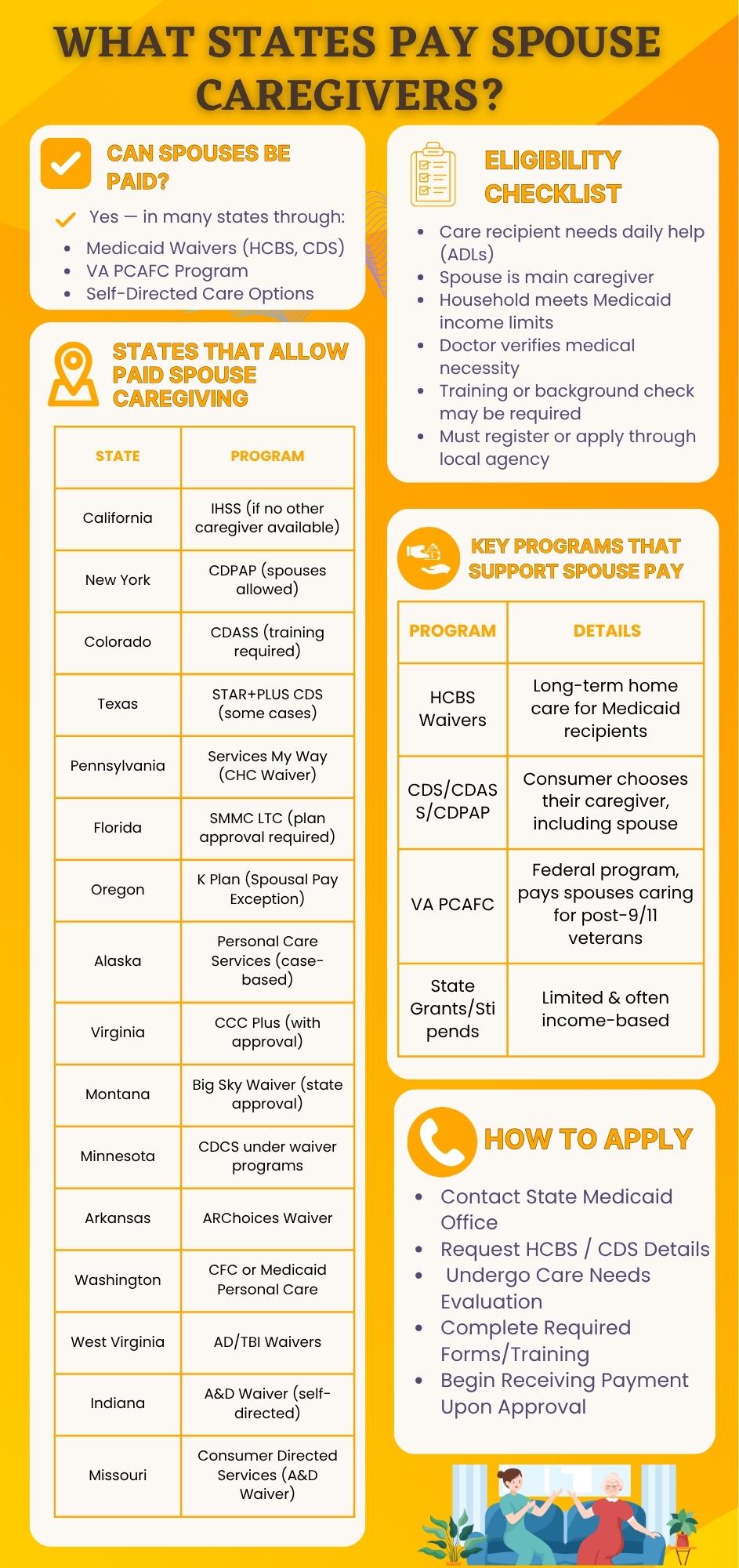
In these states, spouses who provide care may be paid through Medicaid waivers, self-directed care, or other special exemptions. Different programs have different regulations, and not all of them address every situation.
California – IHSS (In-Home Supportive Services) allows spouse payments in limited cases if no other caregiver is available
New York – CDPAP (Consumer Directed Personal Assistance Program) allows spouses to be hired and paid as caregivers.
Colorado – CDASS (Consumer Directed Attendant Support Services) permits spouses to be paid if they meet training and oversight rules.
Texas – STAR+PLUS Waiver includes Consumer Directed Services (CDS), where spouses may qualify in some instances
Pennsylvania – Services My Way under Community HealthChoices lets spouses get paid through self-direction
Florida – SMMC LTC (Statewide Medicaid Managed Care Long-Term Care) may allow spouse payments with managed care plan approval
Oregon – Spouses can be paid under the Spousal Pay Exception in the K Plan (Community First Choice option)
Alaska – Offers Personal Care Services that sometimes allow spouse payments depending on care level.
Virginia – CCC Plus waiver with self-directed options may include spouses in approved cases
Montana – Big Sky Waiver has a self-direct model that may include spouses with state approval.
Minnesota – Consumer Directed Community Supports (CDCS) under waiver programs may allow spouses as caregivers
Arkansas – ARChoices Waiver offers self-direction, where spouses may qualify.
Washington – Spouses can be paid under Medicaid Personal Care or CFC with approval
West Virginia – TBI Waiver and AD Waiver allow self-directed care with possible spouse inclusion.
Indiana – Aged & Disabled Waiver allows self-directed services that may include spouse caregivers.
Missouri – Consumer Directed Services under the Aged and Disabled Waiver may allow spouses if they qualify
Each of these states has its own rules, and getting approval often depends on things like where you live, medical need, or the fact that there aren't enough caregivers available.
Important programs help families by letting spouses work as paid caregivers if they follow specific rules. In many states, the Medicaid Home and Community-Based Services (HCBS) Waivers make this help possible. These waivers allow people who require long-term care to get it at home instead of in a hospital or nursing facility. People in some states can use self-directed care, which lets them choose their caregiver, even if it's their spouse, as long as state law allows it.
Several states use the Consumer-Directed Services (CDS) method inside the HCBS framework. It allows families more control over jobs, care plans, and choices about how to provide care. If no other qualified caregiver is available and the care plan allows it, a spouse may be paid to provide care under CDS. The VA's Program of Comprehensive Assistance for Family Caregivers (PCAFC) helps veterans who were hurt while serving in the military after 9/11.
This program gives spouses caregiver training, a monthly salary, and other advantages. It is one of the most reliable options because it is available in every state and has a national framework. Some governments also help with caring by giving out funds or running programs that are backed by the state. These might come in many ways, but they could give spouses in homes who qualify for Medicaid stipends, monetary help, or short-term care. There aren't many of these non-Medicaid options, and they are sometimes only available in rural regions or when the budget is tight. These programs strive to make life easier for families and help people age or recover at home. They also recognize the important role that spouse caregivers play.
To be paid as a spouse caregiver, the majority of programs demand the following:
Spouses must be the primary caregiver, providing consistent daily support.
Care recipient must need help with activities like bathing, dressing, or mobility every day
Household must meet income limits, and the care recipient must qualify for Medicaid or the specific program
Some states require the caregiver to enroll or register with an approved agency or managed care provider
A doctor or caseworker may need to confirm that in-home care is medically necessary
Care plans often require approval before payments begin and may include training or documentation
To receive payment for being a spouse caregiver, you first need to contact your state's Medicaid office. Ask about Consumer-Directed Services (CDS) or Home and Community-Based Services (HCBS). Most of these programs require a care needs evaluation, proof of Medicaid eligibility, and approval of a care plan, even if they are all different. You may need to sign up with a local provider agency or finish your training as a caregiver. For more help, get in touch with your local Area Agency on Aging or Disability Office. They connect you with services and assist families in filling out forms. You can find the right people to talk to in your area by going to state websites.
You can receive compensation for caring for your spouse in specific places through self-directed care, Medicaid waivers, or VA programs. Income, medical necessity, and particular state program regulations all affect eligibility.
No, not all states reimburse spouses for providing care. While some states limit spousal compensation unless specified exceptions or medical criteria are met, others permit it through certain waivers or self-directed programs.
Under Medicaid self-directed or veteran programs, spouses who care for their partner usually make between $12 and $20 an hour. The exact amount depends on the typical wage for home care aides in your state.
Training and certification requirements for spouse caregivers vary by state and program. They often have to pass background checks and basic caregiver training that teaches them about safety, medication, and infection control. Some programs also require you to register with an agency, get certified in self-directed care, or get certified in CPR.
Yes, qualifying spouse caregivers of post-9/11 veterans are supported nationwide through VA's Program of Comprehensive Assistance for Family Caregivers (PCAFC). In every state, it provides health coverage, respite care, caregiver training, and monthly stipends.
Your state, your loved one's medical needs, and the program you apply via will all determine whether or not you can get paid as a spouse caregiver. In rare cases, some states only allow spousal pay, while others make it easy to get paid through Medicaid exemptions or VA benefits. There may be various rules for each county, program, and provider network.
If you're feeling overwhelmed by the process or don't know where to start, GoInstaCare can help. You can locate dependable help, local programs, and guidance through their caregiver matching service. GoInstaCare can help committed spouses like you care for their loved ones more effortlessly, whether they need a break, extra help, or long-term preparation.
Cities
Houston
Dallas
Austin
San Antonio
Miami
Chicago
Find Here